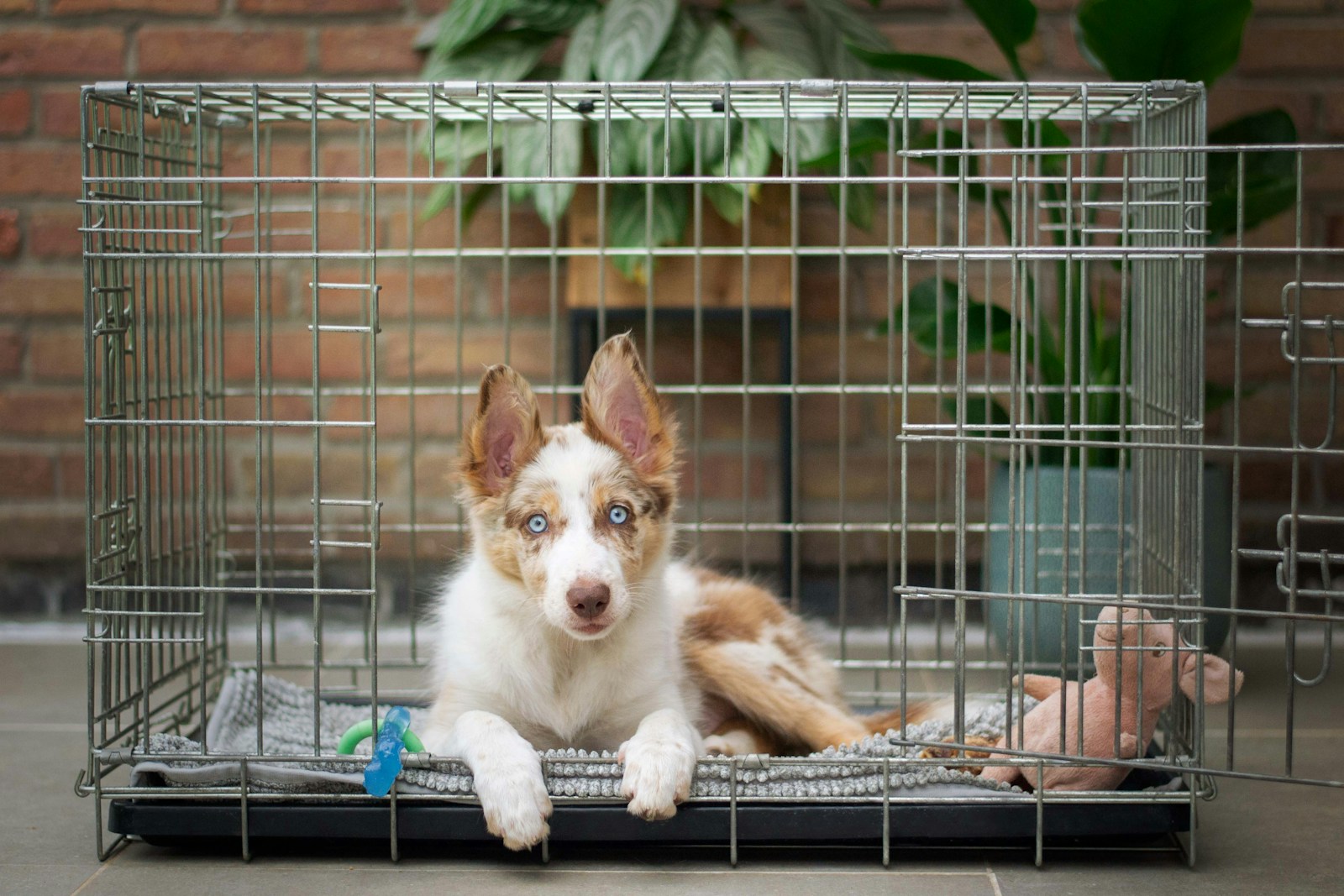
A crate that's the wrong size undoes most of the training benefits it's supposed to provide. Too small, and your dog is cramped and reluctant to go in. Too large, and a puppy can use one end as a bathroom and still have plenty of room to sleep away from the mess. Getting the size right the first time saves you money, saves your dog stress, and makes house training dramatically easier.
Here's exactly how to measure your dog, what size to buy, and which crate style fits your situation.
New puppy at home? Grab our free New Puppy Checklist — a 14-page room-by-room guide with supply lists, a first-week plan, and 10% off your first order. Perfect companion to this crate guide.
The Rule That Matters More Than Breed Charts
Breed and weight charts are a helpful starting point, but they're estimates. The real rule is this: your dog should be able to stand up without ducking, turn around in a full circle without stepping over their own body, and lie down fully stretched out, on their side, without touching the crate walls.
That's the ceiling for space, not the floor. A crate that lets your dog do all three comfortably — with a little room to spare, not a lot — is the right size. More room than that isn't a kindness for a puppy in house training; it's an invitation to soil one corner and sleep in the other.
How to Measure Your Dog for a Crate
Skip the guesswork and measure directly. You'll need two numbers.
Length: Stand your dog square on all four legs. Measure from the tip of their nose to the base of their tail (not the tip of the tail — the base, where it meets the body). Add 2 to 4 inches: 2 inches for small dogs, closer to 4 for large and giant breeds.
Height: Measure from the floor to the top of the head or the tips of the ears, whichever is taller when your dog is sitting upright. Add a few inches for headroom.
Whichever measurement produces the bigger crate size, go with that one. If your dog is still growing, measure again every few weeks, or estimate adult size using breed averages and buy for the dog they'll become — using a divider panel in the meantime (more on that below).
If you're stuck between two sizes, most trainers recommend sizing down for house training and sizing up only once training is solid and the crate is being used more for calm rest than potty control.
Dog Crate Size Chart by Weight and Breed
Use this as your starting point, then confirm with your own measurements. Sizes below reflect standard industry naming (XS through Giant/XXL) and their typical exterior length in inches.
|
Crate Size |
Length |
Dog Weight |
Example Breeds |
|
XS (24") |
~24" |
Up to 12 lbs |
Chihuahua, Yorkshire Terrier, Pomeranian, Toy Poodle |
|
S (30") |
~30" |
13–25 lbs |
Shih Tzu, French Bulldog, Boston Terrier, Miniature Schnauzer |
|
M (36") |
~36" |
26–40 lbs |
Beagle, Cocker Spaniel, Corgi, American Eskimo Dog |
|
L (42") |
~42" |
41–70 lbs |
Border Collie, Australian Shepherd, Standard Poodle, Boxer |
|
XL (48") |
~48" |
71–90 lbs |
Labrador Retriever, Golden Retriever, German Shepherd, Husky |
|
XXL (54") |
~54" |
91–110+ lbs |
Doberman, Rottweiler, Bernese Mountain Dog |
|
Giant (54"+) |
54"+ |
110+ lbs |
Great Dane, Mastiff, Saint Bernard, Irish Wolfhound |
A few notes on the chart. Body shape matters as much as weight. A long, lean dog like a Greyhound or a Doberman often needs more length than their weight alone would suggest, while a stocky, compact dog like a Bulldog or Corgi may fit into a smaller footprint despite being heavier than their height implies. When your dog falls between two rows, measure first and let the tape, not the scale, make the call.
Explore crates and every other containment option in our containment collection.
Why Crate Size Matters for House Training
Dogs have a natural instinct not to soil the area where they sleep. A properly sized crate leans into that instinct — there's nowhere to go except right where they're lying, so they learn to hold it and signal you instead. This is the entire mechanism behind crate-based house training, and it only works if the crate is snug enough that "somewhere else in the crate" isn't an option.
An oversized crate breaks this. If there's enough floor space for your puppy to potty in one corner and curl up in the other, the den instinct has nothing to push against. Owners in this situation often assume their puppy is "just not getting it" when the real issue is a crate that's a full size too big.
This is also why sizing up "for the future" without a divider backfires for puppies. It feels efficient — buy once, use for years — but it can add weeks to house training. The fix isn't to avoid buying the adult-size crate; it's to use a divider panel until your puppy grows into the space.
Wire, Plastic, or Soft-Sided: Which Material Fits Your Situation
Wire crates are the most common choice for home use, and for good reason. They fold flat for storage, offer maximum airflow and visibility (which helps anxious dogs feel less isolated), and almost all of them come with a divider panel included or available separately. They're easy to clean and widely available in every size. The tradeoff: they're not great for travel, and a determined chewer or escape artist can sometimes bend wire over time.
Plastic (travel) crates are enclosed on three sides with a wire door, which creates a more den-like, secure feeling that some dogs — especially anxious ones — settle into faster. They're the standard for airline travel because they meet IATA carrier requirements, and they're sturdier for dogs who tend to chew or paw at wire. The downsides are less visibility and airflow, and they don't fold down as compactly.
Soft-sided crates are lightweight and portable, ideal for already house-trained, calm dogs who need something for travel, camping, or a hotel stay. They are not a good choice for puppies, chewers, or dogs still working through separation anxiety, since determined dogs can tear or unzip their way out.
Heavy-duty or aluminum crates are worth the higher price for dogs with serious escape histories — bent latches, chewed-through wire, or crates walked across the room. They're overkill for most dogs but solve a real problem for the ones that need them.
For most house training situations, a standard wire crate with a divider panel is the right starting point. See the full lineup, including heavy-duty options, in our containment collection.
When Puppies Need a Divider Panel
If you're buying a crate sized for your dog's adult weight (the smart, budget-friendly move), your puppy needs a divider panel to shrink the usable space down to just enough room to stand, turn, and lie down — nothing more.
Here's roughly how that plays out as your puppy grows:
• 8–10 weeks old: Smallest divider setting, just enough space for the puppy's current size, with almost no extra room.
• 3–4 months old: Move the divider back as your puppy grows, always keeping the fit snug rather than roomy.
• 5–6 months old: Continue adjusting every few weeks based on how your puppy is filling the space.
• Adult size reached: Remove the divider entirely, or leave it out once house training is fully reliable and the crate is being used for rest rather than potty management.
Most wire crates sized M and up either include a divider panel or sell one as a compatible accessory, so check before you buy if this matters to you. Browse divider-compatible crates and other accessories in our containment collection.
Common Sizing Mistakes to Avoid
Buying based on your dog's current puppy size instead of their adult size. This leads to buying multiple crates as your dog grows. Buy for adult size and use a divider instead.
Ignoring the crate pad or bed. If you plan to add a padded liner or bed inside the crate, account for its thickness. A thick orthopedic pad can eat up an inch or two of usable height and length, which matters for dogs already at the edge of a size range.
Assuming weight is the whole story. Two dogs at the same weight can need different crate sizes depending on their build. A lean, long-bodied dog and a short, stocky dog of identical weight are not interchangeable when it comes to crate length.
Choosing based on price instead of fit. A too-small crate isn't a bargain if your dog refuses to enter it or you have to replace it in three months.
Skipping the measurement step entirely. Charts get you close. A five-minute measurement gets you exact.
Set Your New Puppy Up For Success
The right crate is the foundation, but it's just one piece of the first-month puzzle. Our free New Puppy Checklistcovers everything else — room-by-room puppy-proofing, the complete supply list, first-week and vet-visit priorities, feeding and potty guidance, and simple training summaries you can actually follow. You'll also get 10% off your first order with code WELCOME10.
Frequently Asked Questions
Do I need to buy a bigger crate as my puppy grows, or can I buy the adult size now?
You can buy the adult-size crate right away and use a divider panel to shrink the space to fit your puppy at each stage. This saves money and avoids the hassle of multiple crate purchases. Just make sure the divider keeps the space snug rather than roomy, since too much extra room undermines house training.
What size crate does a Labrador or Golden Retriever need?
Most adult Labradors and Golden Retrievers fit an XL (48") crate, since they typically weigh between 55 and 80 pounds depending on sex and build. Measure your individual dog, since males tend to run larger than females and may need the extra length an XL provides over a Large.
Is it bad to get a crate that's too big?
For house training, yes. A crate with too much extra floor space gives a puppy room to potty in one area and sleep in another, which removes the natural incentive to hold it. For an adult dog who is already reliably house trained, a slightly larger crate used mainly for calm rest is less of an issue, though snug is still generally more comfortable and secure for most dogs.
Should I measure my dog standing or lying down?
Measure standing. For length, measure nose to base of tail while your dog stands square on all four legs. For height, measure floor to the top of the head or ears while sitting upright, whichever is taller. These standing measurements, plus a few inches of buffer, give you the crate size to buy.
What's the difference between wire, plastic, and soft-sided crates?
Wire crates offer the best airflow and visibility and almost always support a divider panel, making them the top choice for house training. Plastic crates are more enclosed and den-like, and they're required for airline travel. Soft-sided crates are the most portable but only suitable for calm, already house-trained dogs, since they're easy for an anxious or determined dog to damage.